For various reasons many Apps need to detect if the phone has been “rooted” and in this article will see different techniques for this purpose. Since it is common to see this type of questions in development forums, I thought a post on the subject would be of interest to many readers.
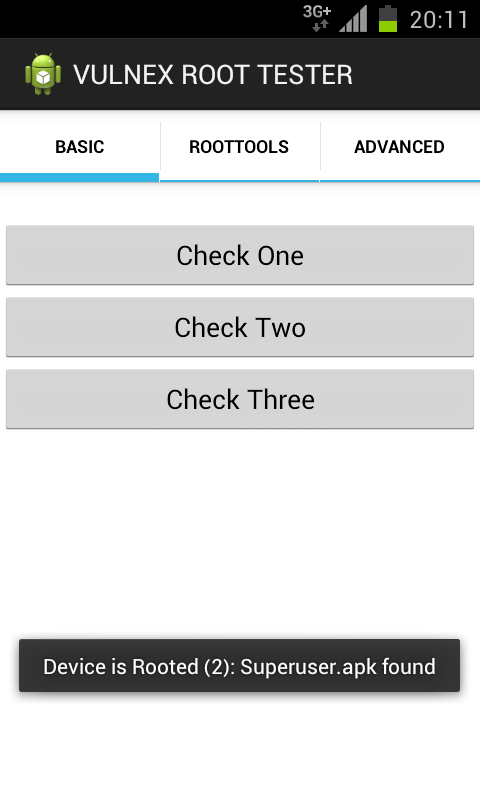
In this StackOverflow post we can find techniques commonly used in Apps for Rooted detection. The following code makes use of three methods for detecting Rooted: the first check for the string “test-keys”, which is a generic key for signing packages; the second method checks whether the Superuser.apk exist in disk, this App manages access to “su” command (administrator privileges) for other Apps; and finally the third method calls “su” directly and runs a root command.
 /**
 * @author Kevin Kowalewski
 *
 */
public class Root {

    private static String LOG_TAG = Root.class.getName();

    public boolean isDeviceRooted() {
        if (checkRootMethod1()){return true;}
        if (checkRootMethod2()){return true;}
        if (checkRootMethod3()){return true;}
        return false;
    }

    public boolean checkRootMethod1(){
        String buildTags = android.os.Build.TAGS;

        if (buildTags != null && buildTags.contains("test-keys")) {
            return true;
        }
        return false;
    }

    public boolean checkRootMethod2(){
        try {
            File file = new File("/system/app/Superuser.apk");
            if (file.exists()) {
                return true;
            }
        } catch (Exception e) { }

        return false;
    }

    public boolean checkRootMethod3() {
        if (new ExecShell().executeCommand(SHELL_CMD.check_su_binary) != null){
            return true;
        }else{
            return false;
        }
    }
}

/**
 * @author Kevin Kowalewski
 *
 */
public class ExecShell {

    private static String LOG_TAG = ExecShell.class.getName();

    public static enum SHELL_CMD {
        check_su_binary(new String[] {"/system/xbin/which","su"}),
        ;

        String[] command;

        SHELL_CMD(String[] command){
            this.command = command;
        }
    }

    public ArrayList
<string> executeCommand(SHELL_CMD shellCmd){
        String line = null;
        ArrayList
<string> fullResponse = new ArrayList<string>();
        Process localProcess = null;

        try {
            localProcess = Runtime.getRuntime().exec(shellCmd.command);
        } catch (Exception e) {
            return null;
            //e.printStackTrace();
        }

        BufferedWriter out = new BufferedWriter(new OutputStreamWriter(localProcess.getOutputStream()));
        BufferedReader in = new BufferedReader(new InputStreamReader(localProcess.getInputStream()));

        try {
            while ((line = in.readLine()) != null) {
                Log.d(LOG_TAG, "--> Line received: " + line);
                fullResponse.add(line);
            }
        } catch (Exception e) {
            e.printStackTrace();
        }

        Log.d(LOG_TAG, "--> Full response was: " + fullResponse);

        return fullResponse;
    }

}
</string></string></string>
Apps on a not rooted phone cannot run either of these methods, since all Android Apps by default are in a sandbox (a system of process isolation) and with limited privileges.
The three methods described may be the most common and if we reverse engineering often we can find them in well-known Apps.
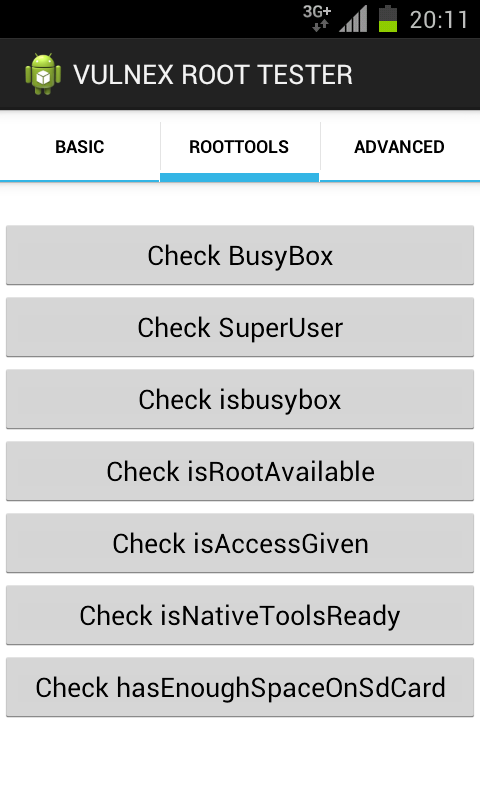
Other techniques include the use of the fantastic RootTools library that facilitates the development of Apps that need root offering various tools. Many Apps use this library.
Library features include check if it exists or offers to install BusyBox (program that combines many Unix utilities in a small single executable), check if it exists or offers to install SuperUser, verify that App has root access, native tools or enough space on the SD Card.
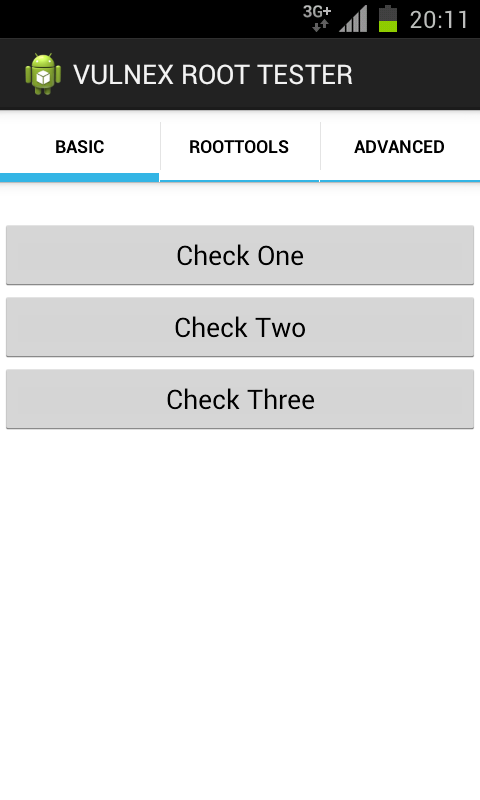
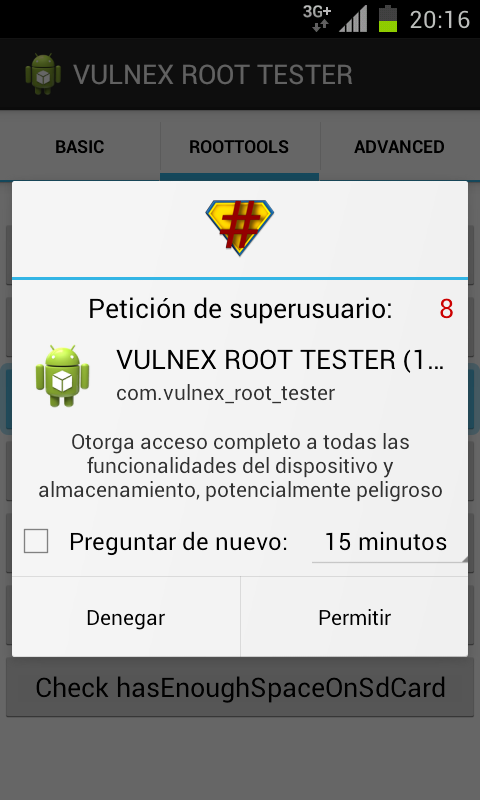
As an exercise to test these root detection techniques, I have written the VULNEX ROOT TESTER that combines different techniques from the basic here presented to some more sophisticated that we will cover in another post. Find below some screenshots of the tool.
No doubt the ability to detect Rooted may be necessary for certain Apps that require a high level of security, but also for many legitimate Apps, such as various security Apps, that require root to function properly or take maximum advantage of the Android platform.
We have to bear in mind that to develop a secure App it is not enough to detect Rooted, but we should think about making a threat modeling of the potentials risks to our App, secure development practices (for example OWASP Mobile) and apply code obfuscation techniques among many other security measures, in order to mitigate vulnerabilities and hinder reverse engineering. My recommendation is that if you are not familiar with these concepts you should talk to some application security professional and get help.
What techniques is your App using to detect Rooted, if any?
Last May 10 and 11 the course of Computer Forensic Expert was held in Reus (Spain) by the Asociación Nacional de Tasadores y Peritos Judiciales Informáticos (ANTPJI), which I am member and one of the instructors, where I had the pleasure of giving a talk on two of my passions such as Python and OSINT (Open Source Intelligence).
Python is a great language to quickly develop all kinds of powerful applications with lots of libraries to perform exploits, reverse engineering, web analysis tools and more. No doubt a useful knowledge for any security expert.
Internet is immense, sheltering all unimaginable information and this is the reason why OSINT techniques are vital to collect, analyze and present this information.
For this course, I decided it would be interesting for attendees to learn how to develop simple tools (scripts) that allow them to perform OSINT using Python with a series of practical exercises with a specific objective each.
Note: I have removed from the scripts the Google Hacking query, so the reader can insert its own query.
Tool #1
Objective: search ANTPJI members on LinkedIn using Google Custom Search API.
These scripts are very simple and do the same thing but in a different way. The first one uses the Google API Client, while the second uses the fantastic Requests library.
In these scripts we are using some Google Hacking to find members of the association on LinkedIn.
# File: ex1_a.py
# Date: 05/14/13
# Author: Simon Roses Femerling
# Desc: Basic Google Hacking
#
# VULNEX (C) 2013
# www.vulnex.com

import const
from apiclient.discovery import build
import pprint

# your google hacking query
query=''
query_params=''

doquery=query+query_params

service = build("customsearch","v1",developerKey=const.cse_token)

res = service.cse().list(
    q=doquery,
    cx=const.cse_id,
    num=10).execute()

pprint.pprint(res)

# VULNEX EOF
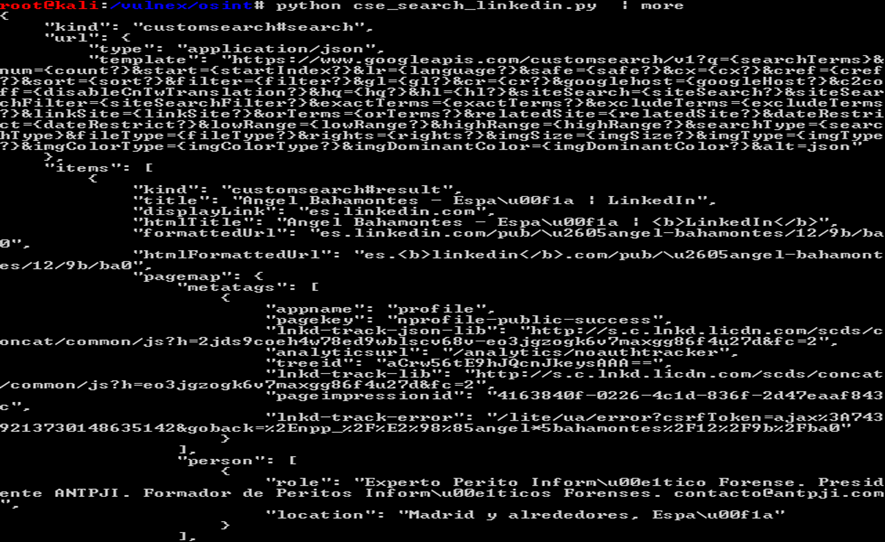
When running any of these scripts, we get the following result:
Not too interesting for the moment :)
Tool #2
Objective: obtain photos of the ANTPJI members LinkedIn profiles using Google Custom Search API.
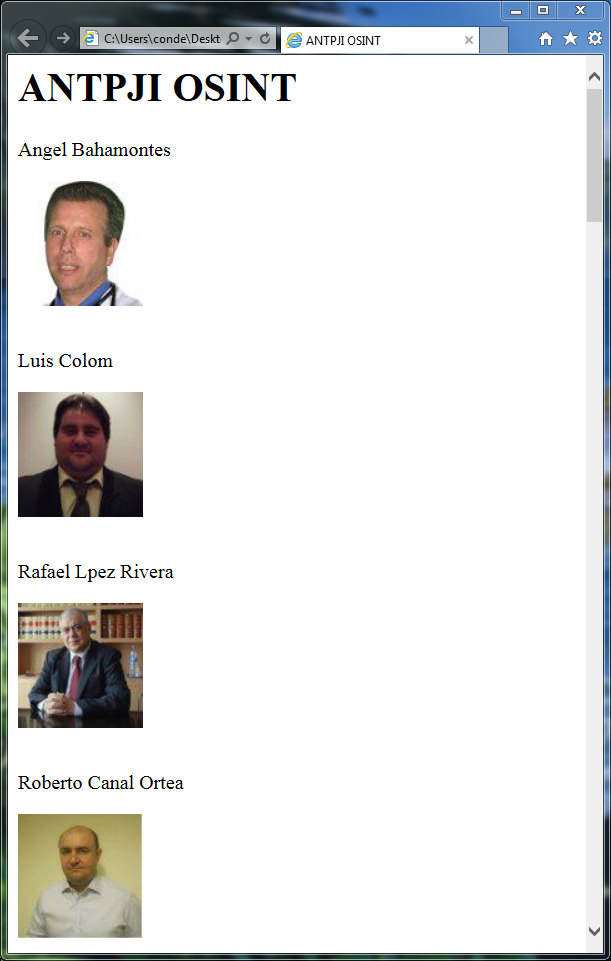
The following script gets the photos of the members of the association on LinkedIn and also extracts picture metadata ;) The script generates an HTML page with all the photos.
# File: ex2.py
# Date: 05/14/13
# Author: Simon Roses Femerling
# Desc: Download picture and extract metadata
#
# VULNEX (C) 2013
# www.vulnex.com

import const
from apiclient.discovery import build
import pprint
import os
from PIL import Image
from StringIO import StringIO
from PIL.ExifTags import TAGS
import requests
import markup

def do_query(istart=0):
    if istart == 0:
        res = service.cse().list(
        q=doquery,
        cx=const.cse_id,
        num=10).execute()
    else:
        res = service.cse().list(
        q=doquery,
        cx=const.cse_id,
        num=10,
        start=istart).execute()
    return res

pic_id=1
do_stop=10
cnt=1

page=markup.page()

# Set page title
page.init(title="ANTPJI OSINT")
page.h1("ANTPJI OSINT")

# Set output directory
out_dir = "pics_gepl"

# Your Google Hacking query
query=''
query_params=''

doquery=query+query_params

service = build("customsearch","v1",developerKey=const.cse_token)

if not os.path.exists(out_dir):
    os.makedirs(out_dir)

res=[]
while True:
    if cnt==1:
        res = do_query()
    else:
        if not res['queries'].has_key("nextPage"): break
        res = do_query(res['queries']['nextPage'][0]['startIndex'])
    cnt+=1
    if cnt > do_stop: break
    if res.has_key("items"):
        for item in res['items']:
            name=""
            if not item.has_key('pagemap'): continue
            if not item['pagemap'].has_key('hcard'): continue
            hcard = item['pagemap']['hcard']
            for card in hcard:
                pic_url=""
                if 'title' in card:
                    if 'fn' in card: name = card['fn']
                    if 'photo' in card: pic_url = card['photo']
                if pic_url != "":
                    image = requests.get(pic_url)
                    pic_n = os.path.join(out_dir,"%s.jpg") % pic_id
                    file = open(pic_n,"w")
                    pic_id+=1
                    try:
                        i = Image.open(StringIO(image.content))
                        if hasattr(i,"_getexif"):
                            ret = {}
                            info = i._getexif()
                            if info:
                                for k,v in info.items():
                                    decode = TAGS.get(k,v)
                                    ret[decode] = v
                                print ret
                        i.save(file,"JPEG")
                        page.p(name.encode('ascii','ignore'))
                        page.img(src=pic_n)
                        page.br()
                        page.br()
                    except IOError, e:
                        print "error: %s" % e
                    file.close()

# Set your output filename
with open('index_gepl.html','w') as fp:
    fp.write(str(page))

# VULNEX EOF
And this is the result:
With few lines of code we have got a very interesting tool.
Tool #3
Objective: what is the relationship of ANTPJI members on LinkedIn?
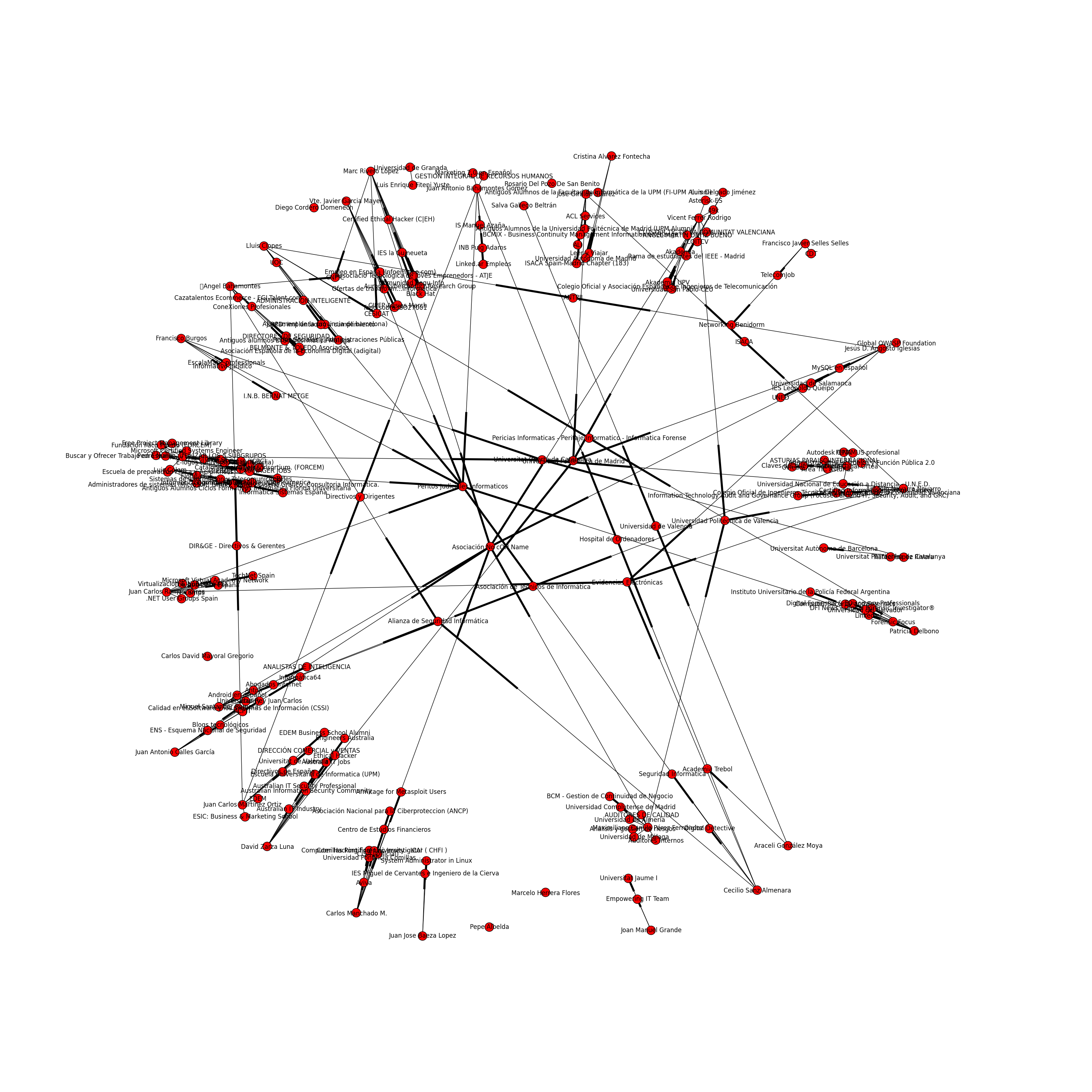
With this script we are looking for the relationship between the members of the association at LinkedIn and create a graph that relates the words.
# File: ex3.py
# Date: 05/14/13
# Author: Simon Roses Femerling
# Desc: Build graph from profiles
#
# VULNEX (C) 2013
# www.vulnex.com

import const
from apiclient.discovery import build
import networkx as nx
import matplotlib.pyplot as plt

def do_query(istart=0):
    if istart == 0:
        res = service.cse().list(
        q=doquery,
        cx=const.cse_id,
        num=10).execute()
    else:
        res = service.cse().list(
        q=doquery,
        cx=const.cse_id,
        num=10,
        start=istart).execute()
    return res

do_stop=10
cnt=1

# Your Google Hacking query here
query=''
query_params=''

doquery=query+query_params

service = build("customsearch","v1",developerKey=const.cse_token)

G=nx.DiGraph()
res=[]
while True:
    if cnt==1:
        res = do_query()
    else:
        if not res['queries'].has_key("nextPage"): break
        res = do_query(res['queries']['nextPage'][0]['startIndex'])
    cnt+=1
    if cnt > do_stop: break
    if res.has_key("items"):
        for item in res['items']:
            name=""
            if not item.has_key('pagemap'): continue
            if not item['pagemap'].has_key('hcard'): continue
            hcard = item['pagemap']['hcard']
            for card in hcard:
                if 'title' in card:
                    if 'fn' in card: name = card['fn']
                G.add_edge(name,card["fn"])

plt.figure(figsize=(30,30))
nx.draw(G)
# Set your output filename
plt.savefig('antpji_rela_map.png')

# VULNEX EOF
And this is the graph generated:
Tool #4
Objective: what’s hot on Twitter account of the association?
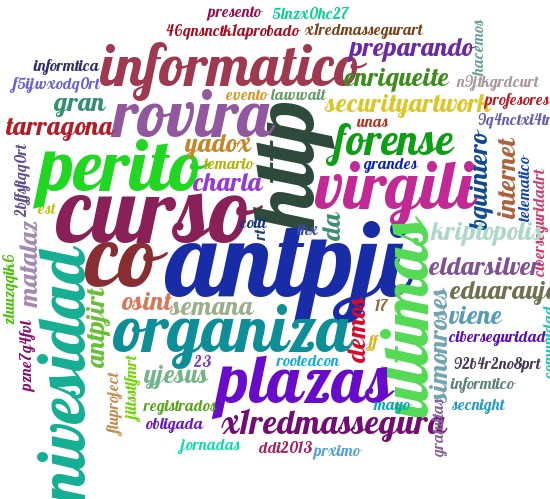
This script downloads the latest tweets from the account of the association and generates a tag cloud. Useful to quickly view what are they talking about.
# File: ex4.py
# Date: 05/14/13
# Author: Simon Roses Femerling
# Desc: Create word cloud
#
# VULNEX (C) 2013
# www.vulnex.com

import requests
import json
import urllib
import const

from pytagcloud import create_tag_image, make_tags
from pytagcloud.lang.counter import get_tag_counts

site="http://search.twitter.com/search.json?q="

# Your query here
query=""

url=site+urllib.quote(query)

response = requests.get(url)

tag = []
for res in response.json["results"]:
    tag.append(res["text"].encode('ascii','ignore'))

text = "%s" % "".join(tag)
tags = make_tags(get_tag_counts(text),maxsize=100)
# Set your output filename
create_tag_image(tags,"antpji_word_cloud.png", size=(600,500), fontname="Lobster")

# VULNEX EOF
And this is the tag cloud:
Tool #5
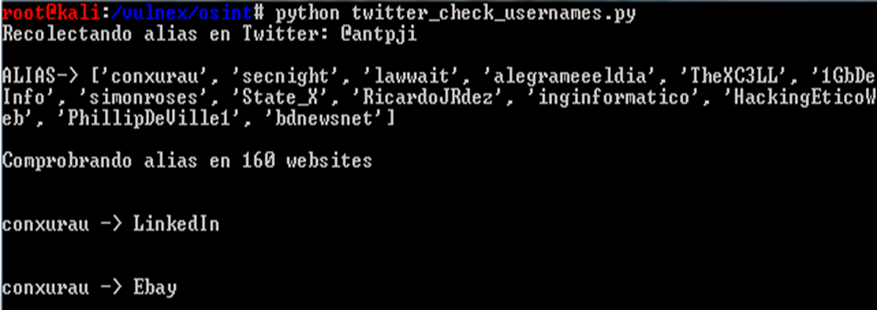
Objective: do the ANTPJI usernames from Twitter exist on social networks sites?
The following script extracts the usernames that have been published or mentioned in the Twitter of the association and checks in 160 social networks sites.
# File: ex5.py
# Date: 05/14/13
# Author: Simon Roses Femerling
# Desc: Check usernames on 160 social network sites
#
# VULNEX (C) 2013
# www.vulnex.com

import requests
import json
import urllib
import const
import pprint

site="http://search.twitter.com/search.json?q="

# Your query here
query=""

url=site+urllib.quote(query)

print "Recolectando alias en Twitter: %s\n" % query
response = requests.get(url)

users = []

for res in response.json["results"]:
    if res.has_key('to_user'):
        if not res['to_user'] in users: users.append(str(res["to_user"]))
    if res.has_key('from_user'):
        if not res['from_user'] in users: users.append(str(res["from_user"]))

print "ALIAS-> %s" % users

print "\nComprobrando alias en 160 websites\n"
for username in users:
    for service in const.services:
            try:
            res1 = requests.get('http://checkusernames.com/usercheckv2.php?target=' + service + '&username=' + username, headers={'X-Requested-With': 'XMLHttpRequest'}).text
            if 'notavailable' in res1:
                print ""
                print username + " -> " + service
                print ""
            except Exception as e:
                print e

# VULNEX EOF
And the result is as follows:
Tool #6
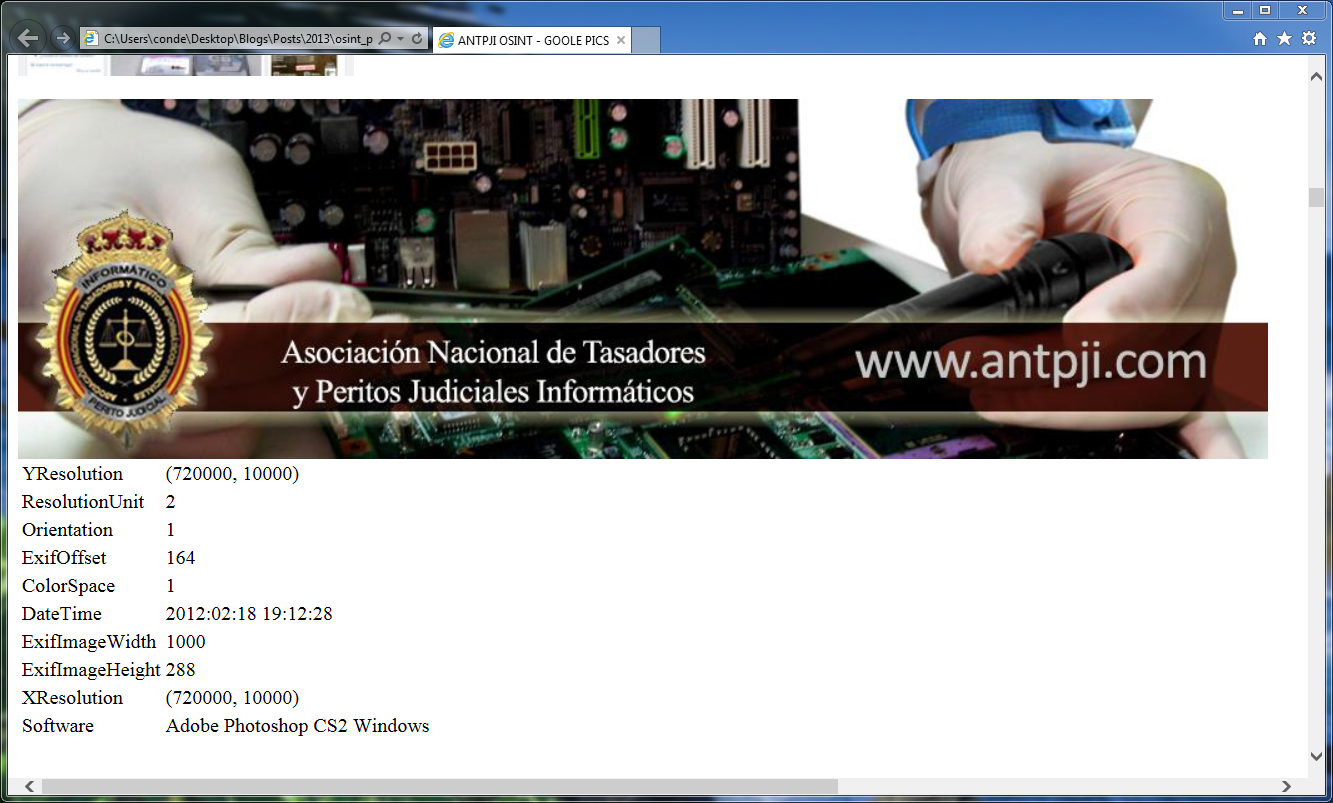
Objective: can we extract metadata from ANTPJI photos?
This script downloads the photos related to ANTPJI from Google and extracts the metadata.
# File: ex6.py
# Date: 05/14/13
# Author: Simon Roses Femerling
# Desc: Download pictures from Google and extract metadata
#
# VULNEX (C) 2013
# www.vulnex.com

import const
from apiclient.discovery import build
import pprint
import os
from PIL import Image
from StringIO import StringIO
from PIL.ExifTags import TAGS
import requests
import markup

def do_query(istart=0):
    if istart == 0:
        res = service.cse().list(
        q=doquery,
        cx=const.cse_id,
        num=10).execute()
    else:
        res = service.cse().list(
        q=doquery,
        cx=const.cse_id,
        num=10,
        start=istart).execute()
    return res

pic_id=1
do_stop=10
cnt=1

page=markup.page()
# Set your page title
page.init(title="ANTPJI OSINT")
page.h1("ANTPJI OSINT")

# Set output directory
out_dir = "pics_gepl"

# Define your Google hacking query here
query=''
query_params=''

doquery=query+query_params

service = build("customsearch","v1",developerKey=const.cse_token)

if not os.path.exists(out_dir):
    os.makedirs(out_dir)

res=[]
while True:
    if cnt==1:
        res = do_query()
    else:
        if not res['queries'].has_key("nextPage"): break
        res = do_query(res['queries']['nextPage'][0]['startIndex'])
    cnt+=1
    if cnt > do_stop: break
    if res.has_key("items"):
        for item in res['items']:
            name=""
            if not item.has_key('pagemap'): continue
            if not item['pagemap'].has_key('hcard'): continue
            hcard = item['pagemap']['hcard']
            for card in hcard:
                pic_url=""
                if 'title' in card:
                    if 'fn' in card: name = card['fn']
                    if 'photo' in card: pic_url = card['photo']
                if pic_url != "":
                    image = requests.get(pic_url)
                    pic_n = os.path.join(out_dir,"%s.jpg") % pic_id
                    file = open(pic_n,"w")
                    pic_id+=1
                    try:
                        i = Image.open(StringIO(image.content))
                        if hasattr(i,"_getexif"):
                            ret = {}
                            info = i._getexif()
                            if info:
                                for k,v in info.items():
                                    decode = TAGS.get(k,v)
                                    ret[decode] = v
                                print ret
                        i.save(file,"JPEG")
                        page.p(name.encode('ascii','ignore'))
                        page.img(src=pic_n)
                        page.br()
                        page.br()
                    except IOError, e:
                        print "error: %s" % e
                    file.close()

# Set your output filename
with open('index_gepl.html','w') as fp:
    fp.write(str(page))

# VULNEX EOF
A picture is worth a thousand words!
As we have seen throughout this article we can easily write sophisticated OSINT tools with a little bit of Python that allows us to gather lots of information about individuals or collectives.
If you would like me to go into any topic in Python and OSINT in depth let me know :)