
Read Time: 18 minutes
TL;DR
In six days this month, Microsoft 365 fell over for most of a day, the FAA grounded every flight in American airspace, the NSA’s classified network blinked out, half a dozen big US banks stumbled, and United Airlines lost the ability to tell its pilots how much their planes weighed. It looked, for a nervous week, like something coordinated. It was not. Every one of these has a mundane, separately documented cause, and in every case the people investigating found no evidence of a cyberattack, and Microsoft went out of its way to say no AI agents were involved either. So this is not a the-sky-is-falling piece, because the sky is not falling. But I want to make the opposite case to panic and still leave you a little uneasy: the reason a bad week looked like an attack is that our systems are now fragile enough to produce an attack-shaped week all on their own, from nothing more exotic than an old router, a three-month-old bug and a bad maintenance window. The comforting news is that nobody did this to us. The uncomfortable news is that nobody had to.
A note on what this is. This is an incident analysis built entirely on public reporting, gathered in the days after the events, with sources linked throughout. Root-cause findings for several of these were still preliminary as I wrote, so where a cause is provisional or contested I say so. The aim is to weigh the explanations honestly, not to pick the scariest one.
One week, five failures
Lay them out in order, because the sequence is part of why it felt like a pattern.
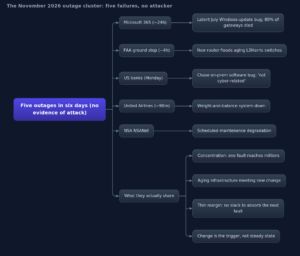
On 12 and 13 November, Microsoft 365 suffered a near day-long global outage. Exchange Online was worst hit, and Outlook, Teams, SharePoint and Copilot degraded with it. Microsoft’s preliminary post-incident report traced it to a defect introduced by a Windows update pushed to its Microsoft 365 gateway servers back in July. Under heavy load an internal process hit lock contention, exhausted CPU and memory, and within two hours more than 80% of those gateway servers had stopped responding. The bug had sat dormant for three months, partly because Microsoft’s own test labs ran on less powerful hardware with fewer cores and never reproduced the conditions that triggered it. Microsoft stated the outage was “a technical failure, with no indication of malicious activity or involvement from AI agents.”
On 13 November, hours later, the FAA issued a nationwide ground stop. A communications failure that began in the Chicago area spread across air route traffic control centres, and for more than four hours nearly 3,500 flights were held on the ground, cascading into roughly 8,000 cancellations and more than 10,000 delays. The provisional cause is deeply unglamorous: during a routine project to replace copper wiring with fibre at a remote facility in Arkansas, equipment run by the FAA’s telecoms contractor L3Harris malfunctioned, and a newly installed router reportedly began firing around a thousand connection attempts every four to five seconds, overwhelming the older switches and corrupting the data feeding controllers’ screens. Homeland Security’s Markwayne Mullin summed it up as new equipment overwhelming older systems, and said there was no evidence of a cyberattack or foreign interference. The FAA’s new AI air-traffic tool was floated as a suspect and specifically denied by both the agency and its developer.
On 16 November, several large US banks wobbled. JPMorgan Chase was the clearest case, with online banking, some branches and Zelle payments disrupted for much of a Monday afternoon. Chase attributed it to “a software bug in an on-premise hardware system” and said plainly that the issue “is not cyber-related.” Customers of Bank of America, Wells Fargo and others reported problems in the same window, though some banks said their own systems were fine.
Also on 16 November, United Airlines hit a roughly 90-minute system outage that stopped it from producing final weight-and-balance figures, the numbers a crew needs before takeoff. A union memo put it bluntly: “The Company cannot provide outbound flights with final weights.” United said there was no indication the outage was related to a cybersecurity issue.
And across mid-November, the NSA’s classified internal network, NSANet, suffered what the agency called “temporary degradation during scheduled routine maintenance,” adding that mission-critical capabilities stayed up. CNN, citing six sources, reported no evidence the disruption came from a cyberattack.
Five systems, five very different operators, six days. You can see why people started drawing lines between the dots.
The explanations we reach for
When a lot breaks at once, the mind wants one cause. Let me take the candidates in turn, including the frightening ones, and weigh each on the evidence rather than the vibe.
Was it a coordinated attack, or a nation-state? This is the first place a security person’s mind goes, and it is the one the evidence most clearly rejects. In every single incident, the investigators who would know said there was no sign of it: Mullin on the FAA, Chase on the banks, United on its outage, CNN’s sources on the NSA, and Microsoft on its own. No actor has claimed anything, no common intrusion has surfaced, and the causes that have surfaced are internal and specific to each operator. Could a later forensic report change one of these? Yes, and I would not bet my house that every one of these stories is fully told. But “five unrelated organisations were quietly owned in the same week and all of them happened to also have a plausible internal bug to point at” is a far heavier claim than the evidence currently supports, and extraordinary claims need more than a spooky calendar.
Was it AI agents? This one deserves real attention rather than a reflexive dismissal, because it is my beat and because, tellingly, officials had to address it directly. I have spent this year documenting that autonomous attack frameworks are now run at scale for the price of a coffee per attempt, so an agentic cause is no longer a silly question, and the fact that Microsoft pre-emptively said “no involvement from AI agents” and the FAA had to deny that its own AI tool caused the ground stop tells you how far the Overton window has moved in a year. But move past the novelty and the evidence points the other way. An agent attacking at scale leaves exhaust, the velocity and breadth I keep writing about, and none of that has been reported here. What these incidents share is not a clever adversary but a dumb failure mode, and a latent Windows bug from July is not an agent. The honest read is that the AI-agent question is now reasonable enough to ask, which is genuinely new, but the answer this week is no.
Was it old hardware and software? Here the evidence actually says yes, and loudest for the FAA. Its own officials described new equipment overwhelming older systems, and the ground stop sits on top of an air-traffic infrastructure that has been described as aging for years, which is exactly why the Transportation Secretary was in front of Congress asking for tens of billions to replace it. Aging infrastructure does not usually fail on a quiet day; it fails when you touch it, which is why a fibre upgrade and a new router were enough to bring down a nation’s airspace.
Was it rushed or poorly managed change? This is the thread I find most persuasive across the set, and it is the professional heart of the story. Almost every one of these traces back not to the system in steady state but to a change made to it: a Windows update in July, a network change and a new router at the FAA, a software bug in a bank’s on-premise system, a maintenance window at the NSA. This is not quite the “bad vibe-coding” caricature of AI writing sloppy code, though that risk is real and growing. It is the older, more boring failure of change management and testing. Microsoft’s bug is the perfect parable: the defect was real for three months and nobody saw it because the test environment was weaker than production and never recreated the load that set it off. That is a testing-gap story, and it is the single most repeatable lesson here.
Was it just coincidence? Partly, yes, and it would be dishonest to pretend otherwise. Base rates matter: large systems fail constantly, and in any given week something somewhere is broken. What changed this week was not only the number of failures but our attention to them. Once the Microsoft and FAA outages led the news, every subsequent glitch got reported against that backdrop and mentally filed under the same story, a clustering illusion helped along by genuinely heightened salience. The President’s own reaction to the NSA outage, “things like that happen,” is dismissive but not wrong as base-rate statistics. Some of the apparent pattern is real fragility; some of it is us noticing.
Was there an unknown factor? In at least one case, honestly, we do not fully know yet. The FAA’s own administrator said the L3Harris explanation “did not serve as a full explanation of the root cause,” and a cybersecurity adviser publicly questioned whether Chase’s “software bug” was the whole story. Intellectual honesty means holding those open. Not every one of these books is closed, and a responsible analysis leaves room for a later report to complicate the tidy version. As this piece went out, the FAA story was moving in exactly that direction: investigators had reproduced the network overload in testing, but the emerging thread was less a single faulty router than an institutional one, with reporting that the contractor’s upgrade work had proceeded with little monitoring and that the FAA had been warned about the telecom upgrade beforehand. That is not a tidier explanation, but it is a telling one, because it points straight back at change management and oversight rather than away from them.
We have been here before
If this week felt unprecedented, it was not, and the precedents are the strongest evidence for the boring explanation. In July 2024 a single faulty update to CrowdStrike’s Falcon sensor, one bad configuration file, blue-screened around 8.5 million Windows machines within hours and became the largest IT outage in history: more than ten thousand flights delayed or cancelled, banks and hospitals and even some 911 services down, broadcasters off the air. It was not an attack, and CISA and CrowdStrike both confirmed as much. One vendor, one change, a global standstill.
And the twelve months before this cluster were a drumbeat of the same shape. A DNS failure in a single AWS region took out a swathe of the internet for over fifteen hours. A faulty Azure Front Door configuration change knocked over Microsoft’s own services and the apps riding on them. Cloudflare took down an estimated three million sites when a database permissions change doubled the size of an internal feature file. Every one of those was a configuration or software fault, and not one was a cyberattack. Hold the November cluster next to that run and it stops looking like a dark week and starts looking like the ordinary weather of a concentrated, fast-changing system. The story of the modern outage is not the hacker. It is the change that went wrong in a place too much depends on.
What actually connects them
So if it was not one attacker, what is the shared thread, because there is one, and pretending these are five fully random events misses the real lesson.
The connection is structural, not adversarial. Four things show up again and again across this week. There is concentration: a single Microsoft gateway tier, a single telecoms contractor, a handful of banks on shared rails, so that one internal fault radiates out to millions. There is aging infrastructure meeting new technology, most visibly at the FAA, where the act of modernising the old system is what broke it. There is thin margin, the Microsoft outage was made worse because 14% of the relevant capacity was already down from an unrelated issue the day before, so there was no slack to absorb the next problem. And there is change as the trigger, the recurring detail that almost none of these failed while sitting still; they failed when someone updated, patched, migrated or maintained them. None of those four is a hacker. All four are the conditions that make a system brittle, and a brittle system does not need an attacker to have a very bad week.
Why this still matters, even though it was not an attack
Here is the part I most want a defender to take away, and it is the reason a security blog is writing about outages at all. A resilient system and a secure system are built from the same materials. The controls that contain a cyberattack, blast-radius limits, isolation, graceful degradation, tested rollback, real change management, knowing your dependencies, are exactly the controls that would have softened every incident this week. Whether the thing that knocks over your service is a Russian operator, an autonomous agent or a three-month-old bug in a Windows update, the engineering that saves you is identical. That is oddly good news, because it means you do not have to guess the threat to prepare for it. You harden for failure, and attack is just one kind of failure.
And there is a forward-looking point worth sitting with, without overclaiming it. The reason “was it AI agents?” was asked this week, by journalists and by the companies themselves, is that it has stopped being a ridiculous question. We are entering a period where the mundane failure and the agentic attack can produce a similar-looking bad day, and telling them apart quickly will itself become a defensive skill, which is a thing I have argued is now part of the job. This week the answer was the boring one. It will not always be, and the organisations that can tell the difference fast, because they have the logs, the baselines and the dependency maps to actually look, are the ones that will not have to guess.
What to do on Monday
Three moves, none of them about a specific enemy, because the whole point is that you do not need to know the cause to be ready for it.
Know what one failure can reach. Map your real dependencies, the provider, the gateway, the contractor, the shared rail, and find the single faults that radiate to everything you run. You cannot shrink a blast radius you have never drawn, and most of this week was one internal fault reaching much further than anyone had mapped.
Treat every change as the likeliest cause, because it is. Stage it, test it on production-like load rather than a weaker lab, roll it out gradually, and keep a rollback that actually works, remembering Microsoft’s lesson that a change deployed three months ago is one you can no longer simply undo. Almost nothing this week broke while sitting still; it broke when someone touched it.
Rehearse failing small. Build and actually exercise graceful degradation, isolation and manual fallbacks, so that when a system goes down it takes a feature with it and not the whole service, and a bad afternoon stays an afternoon. Assume the outage is coming and decide now how much it gets to take.
So what
Five systems broke in one week and it was not a conspiracy, it was a latent bug, an overloaded router, a maintenance window, an on-premise software fault and a weight-and-balance system, each one boring, each one separately explained, and in no case a confirmed attack. Resist the instinct to weave them into a single dramatic narrative, because the facts do not support it and the panic does not help. But resist the opposite instinct too, the shrug that says these are just glitches and nothing is wrong. Something is wrong, and it is more structural and less cinematic than an enemy: we have built critical systems with too much concentration, too little slack, too much aging infrastructure under too much new change, and too little of the testing and resilience discipline that catches a problem before three months and eighty percent of your servers go by. The fix is not a bigger wall against a villain. It is the unglamorous work of making systems that fail small, fail safe and fail visibly, so that the next bad week, whatever causes it, stays a bad week and not a headline.
Stay calm, stay skeptical of tidy narratives in both directions, and build things that bend instead of snap.
- X (Twitter): @SimonRoses
Further Reading:
- Forbes: Microsoft apologises for the 365 outage and reveals the cause
- Malwarebytes: worldwide Microsoft 365 outage disrupts Outlook, SharePoint, Teams
- CBS News: FAA lifts nationwide ground stop; White House says no indication of a “nefarious act”
- Reuters: FAA issues national ground stop due to an “extraordinary circumstance”
- Al Jazeera: US bank outage, what caused the Chase problems and Zelle delays
- BBC: major banks hit by IT problems
- CBS News: United Airlines resolves a widespread system outage affecting departing flights
- Reuters: United Airlines says a technology issue affected departing flights
- Al Jazeera: NSA attributes classified-network outage to routine maintenance
- BBC: NSA classified network outage
- TechTarget: explaining the largest IT outage in history (CrowdStrike, July 2024)
- The Month AI Switched Sides: October 2026 in Security
- Who Gets Paid When the Machine Does the Work?
Questions or feedback? Reach out via:
- Website: vulnex.com
- AI Security Strategy: vulnex.ai
- Twitter/X: @SimonRoses
- LinkedIn: linkedin.com/in/simonroses
- GitHub: github.com/vulnex
Contact: info@vulnex.com


