I have been wanting to read this book for a long time, finally I managed to make time and I have to admit that it has exceeded my expectations. This magnificent work written by reputed experts in iOS, one of the top mobile platforms, on mobile security such as Charlie Miller, Dion Blazakis, Dino DaiZovi, Stefan Esser, Vincenzo Iozzo, Ralf-Philip Weinmann reveals the secrets of Apple mobile operating system.
iOS Hacker’s Handbook (ISBN: 978-1-118-20412-2) is a fascinating and very technical reading that takes us into the inner working and security of iOS to find vulnerabilities and develop exploits.
Its 11 chapters are full of source code (recommended to understand C and ASM) describing the security architecture of iOS such as encryption, sandboxing, different types of memory protections and code signing to find vulnerabilities through reverse engineering and fuzzing and develop exploits using modern techniques such as ROP.
Some of the crown jewels include the study of real vulnerabilities which have been used to win the mythical Pwn2Own contest, understanding and development of our own jailbreaks and debugging and exploitation of iOS kernel.
Taking into account that the rise of exploits sale and the price of iOS 0day for sure is a very serious and lucrative business, you must read this book (check the Forbes article on the subject)!
The work is focused on the iOS platform so no vulnerabilities and exploitation of Apps are covered, anyway for this topic there are plenty of references so we don’t miss it at all.
Without a doubt this book is a compulsory reading for any security expert who wants to delve into the bowels of iOS at the lowest level. I recommend reading the book few times to assimilate the concepts well and downloading the enclosed source code as it contains various interesting tools that we would need to exploit iOS.
I will take the opportunity of this post to mention that the company VULNEX is offering training on mobile hacking that I am sure may interest you :)
Score (1 rose, very bad / 5 roses, very good): 5 Roses (Recommended Reading)
Python is an easy and powerful programming language that allows us to write sophisticated programs: Dropbox and BitTorrent are excellent examples. It is common that Python programs are delivered in source code, but in some cases different techniques like obfuscation and compilation are applied to protect the code from curious eyes. But do these techniques really work?
In this article we will see some tools that supposedly help us to protect our code and how easily they are subverted.
We have two example programs written in Python: the first one is a simple function that asks for a password and shows a message; the second one is the same but this time we have used a class.
def main():

        a = "toomanysecrets"

        res = raw_input("Please enter your password: ")

        if res == a:
                print "ACCESS GRANTED"
        else:
                print "ACCESS DENIED"

if __name__ == "__main__":
    main()
secretapp1.py
class DoMain:

        def __init__(self):
                self.a = "toomanysecrets"

        def Ask(self):
                res = raw_input("Please enter your password: ")

                if res == self.a:
                        print "ACCESS GRANTED"
                else:
                        print "ACCESS DENIED"

if __name__ == "__main__":
    dm = DoMain()
    dm.Ask()
secretapp2.py
Suppose I don’t want to deliver these programs code, then I have several options. Our first option is to obfuscate the code, thus making it difficult to read.
Pyobfuscate
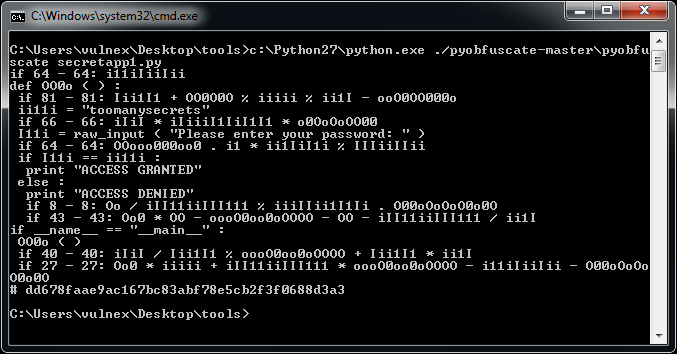
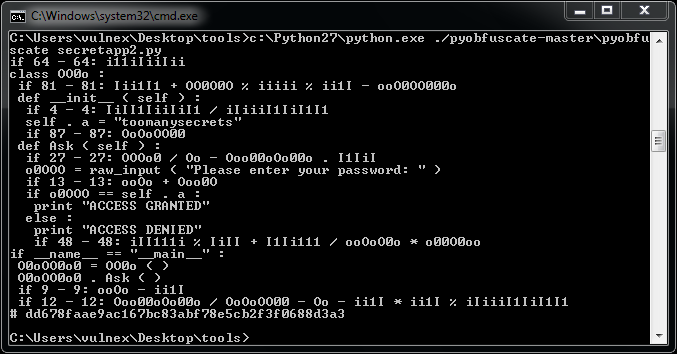
This program allows you to obfuscate the code but it is still completely valid for the Python interpreter. Here is an example with SecretApp1 and SecretApp2.
Fig. 1 – Obfuscated secretapp1
Fig. 2 – Obfuscated secretapp2
At a glance our code makes no sense, but if you look closely at the result we see the text strings in the code and we can recognize Python syntax. It is not too difficult to reconstruct the original code from the obfuscated code.
Despite its limitations, I invite you to visit the tool website to check its possibilities.
Htibctobf
This tool was originally written to solve a challenge in a hacking competition at the Hack in the Box conference. I recommend reading this great article to learn more about it.
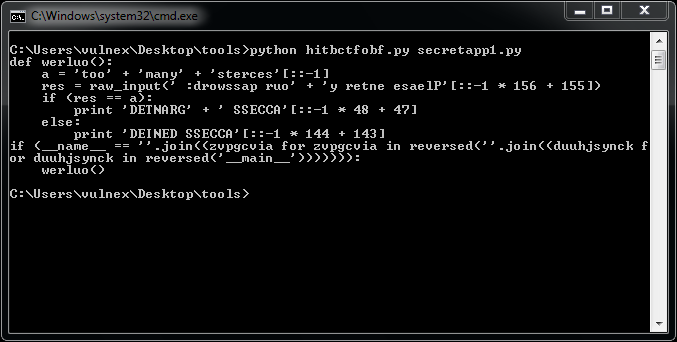
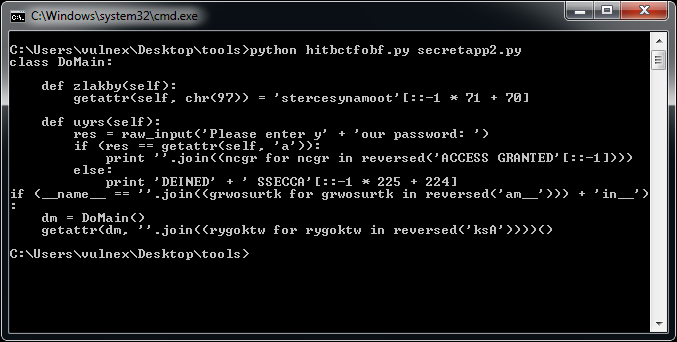
Unlike the previous tool, Htibctobf obfuscates Python code by modifying the AST (Abstract Syntax Trees). When you run this tool, we can see our obfuscated Python code in Fig. 3 and Fig. 4.
Fig. 3 – Obfucated secretapp1
Fig. 4 – Obfuscated secretapp2
We can see the obfuscated code, including text strings, despite that it is not too difficult to reconstruct the original code as well.
Without a doubt an interesting concept with many possibilities, nevertheless it requires improvements to be useful.
In some cases perhaps it is enough to obfuscate the code, but let’s look for other options to protect our code more effectively, therefore we will have to resort to compile our Python code to create an executable.
Py2exe
Possibly one of the most popular choices to turn Python code into a Windows executable. Py2exe
First we have to create a file called Setup that includes a reference to the program we want to build/compile. See setup script.
from distutils.core import setup
import py2exe

setup(console=['secretapp1.py'])
setup.py
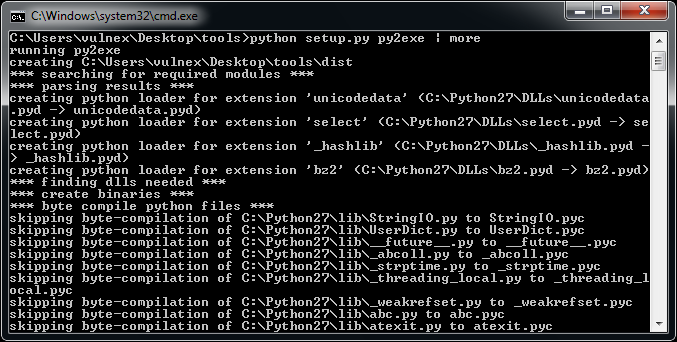
We are now ready to compile our Python code into a Windows executable, so let’s run py2exe. See Fig. 5.
Fig. 5 – Build secretapp1.exe
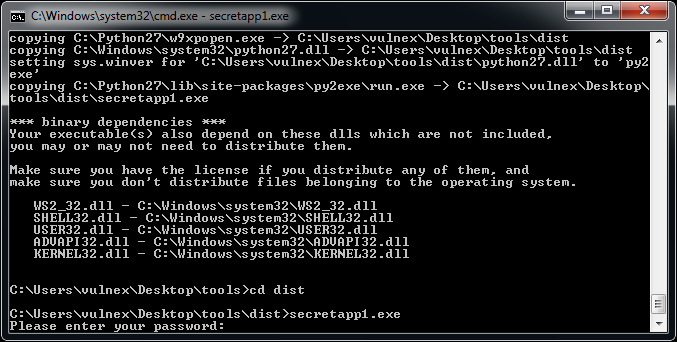
Once the building process is completed, py2exe creates a directory called “dist” which includes our executable and some necessary libraries. In Fig. 6 we can see that py2exe completes successfully and we execute our program in exe format.
Fig. 6 – Build completed!
We could now distribute this binary without fear to give out our code or maybe not?
Py2exe_extract
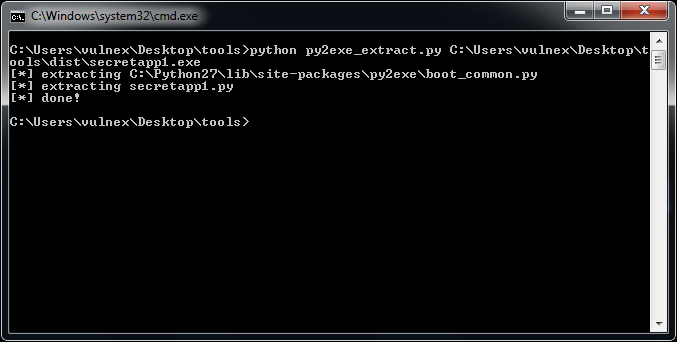
This tool allows us to extract Python object file within the executable created using py2exe, basically inverting the process. Py2exe_extract
In Fig. 7 we can see how we use py2exe_extract to get the object file secretapp1.pyc (the content of this file is platform-independent and is known as Bytecode) from secretapp1.exe.
Fig. 7 – Exctracting object file
Now let’s explore ways to get the code from this object file.
Unwind
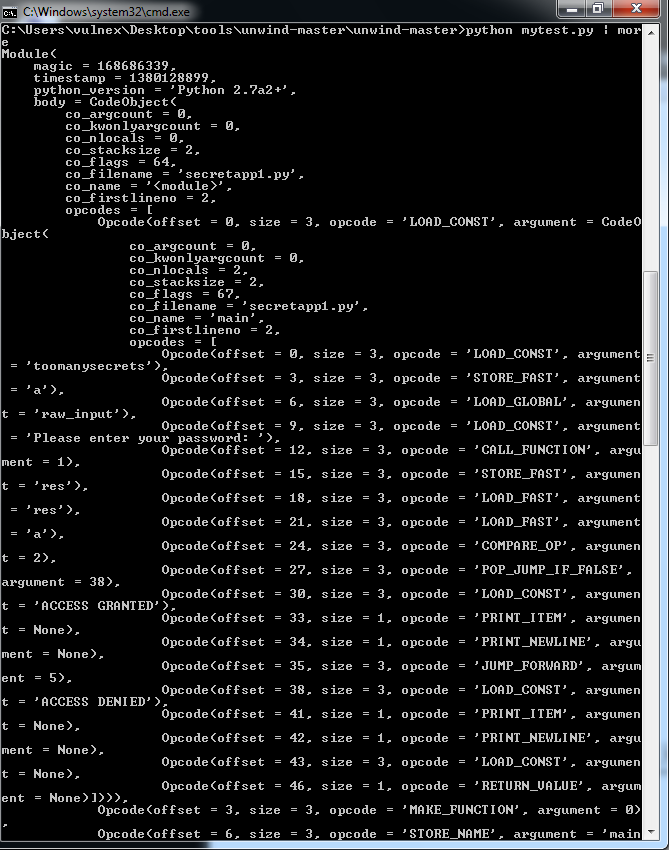
Unwind is a disassembler for Python Bytecode that can be used to analyze object files “.pyc”. For this example, I’ve written a simple script in Python, mytest.py, that imports the disassembler and analyzes the pyc file. See code below.
With this script you can run the following command and get a disassembly of the object file. See Fig. 8.
Fig. 8 – Python Bytecode
For low level lovers this will be your favorite choice ;)
Uncompyle2
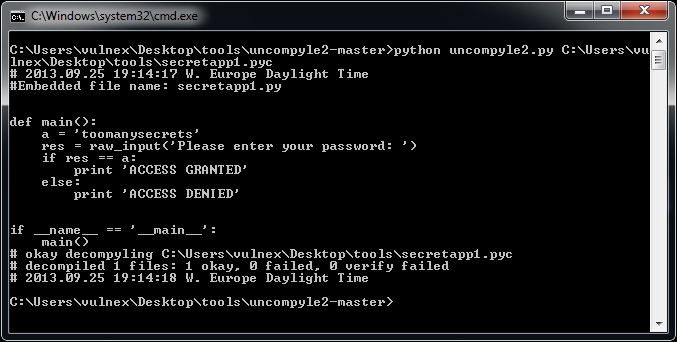
Another option is to use a decompiler like uncompyle2 to get the code directly from the object file “.pyc” without having to go through the disassembly as we previously saw.
This tool is powerful and easy to use as you can see in Fig. 9 using a simple command we get the source code for secretapp1.pyc.
Fig. 9 – Secretapp1 code from object file
Wow, we got source code!
Throughout the article, we have seen some obfuscation and compilation techniques to protect Python code, but we have also been able to subvert the entire protection quite easily :)
The following are other Python compilers that can be used in Windows, Linux, or MacOS, but they suffer from the same problems described in this article.
We could also analyze and subvert binaries using tools such as IDA PRO or Immunity Debugger but I will leave it for a future post. Another interesting tool that I have not mentioned is pyREtic, which is an extensible framework for in-memory Python Bytecode reverse engineering.
For an attacker to get the Python code is a matter of time, however to make things really difficult from a defensive point of view we have to combine different protection techniques.
Do you protect your Python programs? Which methods do you use?
While reading the book synopsis, we realize that this is not the typical book of how to succeed in business. Written by Louis Ferrante, former mobster of the Gambino family and converted writer, compare us the structure of the mafia and its peculiar style of doing business for success in the business world.
Mob Rules: What the Mafia Can Teach the Legitimate Businessman (ISBN: 978-1591843986) is a different and easy to read book that describes lots of basic and logical tips to succeed in business that many entrepreneurs and executives should read and above all apply.
Throughout its three sections (soldier = employee, capo = middle management and don = executives) divided into 88 lessons the book details how the mafia applies these concepts to succeed in business.
The work is full of references to real cases of the mafia and ancient history as examples of what to do or not in business. All of these case studies have been very well selected and in addition are interesting and enhance the message of the author.
For years the Art of War by Sun Tzu has been referenced as the work to apply in business but no doubt Mob Rules is a work to be considered for doing business as well.
The negative point of the work is that some lessons are very basic and do not bring much to the reader.
I recommend the book if you want to apply the lessons for doing business or just enjoying reading a curious book filled with testimonials about the mafia.
Score (1 rose, very bad / 5 roses, very good): 4 Roses (Recommended Reading)