
Read Time: 12 minutes
TL;DR
AI should elevate people, not eliminate them. Every employee with AI becomes a superhuman: faster, smarter, more capable. Yet some companies are choosing mass layoffs instead of empowerment, and AI providers are making the agentic future unaffordable for most users. As of today, April 4, 2026, Anthropic has blocked the use of Claude subscriptions in third-party agents like OpenClaw, forcing users into pay-as-you-go API billing that can easily cost thousands per month. If the agentic era is truly here, it needs to be accessible to everyone, not just companies with deep pockets. The good news: open models and local hardware are emerging as the real path forward.
The Imagination Gap: Why Layoffs Are a Leadership Failure
NVIDIA CEO Jensen Huang said it best in a recent conversation about companies using AI as an excuse to cut headcount:
“For companies with imagination, you will do more with more. For companies that are out of ideas, they have nothing else to do.”
When asked why companies are laying off employees instead of doing more, Huang’s answer was blunt: because the leadership is out of imagination. They look at AI and see a way to cut costs. They don’t see the opportunity to multiply what their existing people can do.
Huang’s vision is clear: every carpenter becomes an architect. Every plumber becomes an engineer. AI doesn’t replace the human; it elevates the human. The person who already understands the work, the context, the customers, the problems, now gets a set of tools that makes them ten times more effective.
That’s the right way to think about AI. Not replacement. Amplification.
JustPaid: A Cautionary Tale
Then there’s the other approach.
JustPaid, a Silicon Valley fintech startup, recently made headlines for building an entire software engineering team out of seven autonomous AI agents powered by OpenClaw and Claude Code. Co-founder Vinay Pinnaka told The Wall Street Journal that the AI agents built ten major features in a single month, each of which would have taken human developers a month to complete.
The cost? Pinnaka claims $10,000 to $15,000 per month for the AI team, compared to what would be hundreds of thousands in developer salaries.
On paper, the math works. In practice, this is a dangerous precedent.
What JustPaid is celebrating is replacing human judgment with autonomous agents that generate code without the context that experienced developers bring. As I wrote in my article on Professional Vibe Coding, 45% of AI-generated code contains security flaws (Veracode, 2025), with no improvement across newer models. Who is reviewing the security of those ten features? Who is making the architectural decisions? Who catches the race condition or the hardcoded API key that the agent missed?
The answer, apparently, is nobody. Or at best, a skeleton crew that’s now responsible for auditing the output of seven tireless machines that don’t understand what they’re building.
This is not innovation. This is cost-cutting disguised as progress.
AI Makes Professionals Better, Not Obsolete
I’ve been using OpenClaw daily as a cybersecurity professional. My agent, AgentX, runs on a Raspberry Pi 5. It checks my email, builds features overnight, monitors my network perimeter, and sends me Telegram summaries every morning. It costs me about $1 to $2 per day in API fees.
But AgentX doesn’t replace me. It multiplies me.
I still design the architecture. I still decide what to build. I still review security-critical code paths. I still make the decisions that require judgment, context, and years of domain expertise. AgentX handles the tedious parts: the boilerplate, the scanning, the repetitive coding tasks. That frees me to focus on the work that actually matters.
This is exactly what Jensen Huang described. I’m a carpenter who became an architect. Not because AI replaced my skills, but because it amplified them. The agent does the heavy lifting. I do the thinking.
The companies choosing layoffs over amplification are telling their employees: “We don’t value your expertise enough to give you better tools. We’d rather replace you with a machine that doesn’t understand the work.”
That’s not a technology problem. That’s a leadership problem.
The Affordability Crisis: Agents Are Too Expensive for Most Users
And now the economics.
Running AI agents requires API access to frontier models. OpenClaw relies on providers like Anthropic (Claude), OpenAI (GPT-4.1), and others. The quality of the agent depends on the quality of the model behind it. That’s the problem.
API costs for serious agentic workloads easily reach hundreds to thousands of dollars per month. Pinnaka himself admitted spending $4,000 per week when he first started experimenting with OpenClaw and Claude Code. Even after optimization, he’s still paying $10,000 to $15,000 monthly. For a VC-backed startup, that’s manageable. For an independent developer in Madrid, Bangalore, or São Paulo? Forget it.
The agentic revolution is real. It’s also priced for enterprises, not for the people who would benefit most from it.
Anthropic’s Subscription Ban: A Step Backwards
And now, as of today, April 4, 2026, it just got worse.
Anthropic has announced that Claude subscriptions can no longer be used with third-party agents, including OpenClaw. Users who were running agents powered by their Claude Pro or Team subscription must now switch to “extra usage,” a pay-as-you-go billing model separate from the subscription.
![Anthropic email announcing the ban of Claude subscription usage in third-party agents like OpenClaw, effective April 4, 2026]
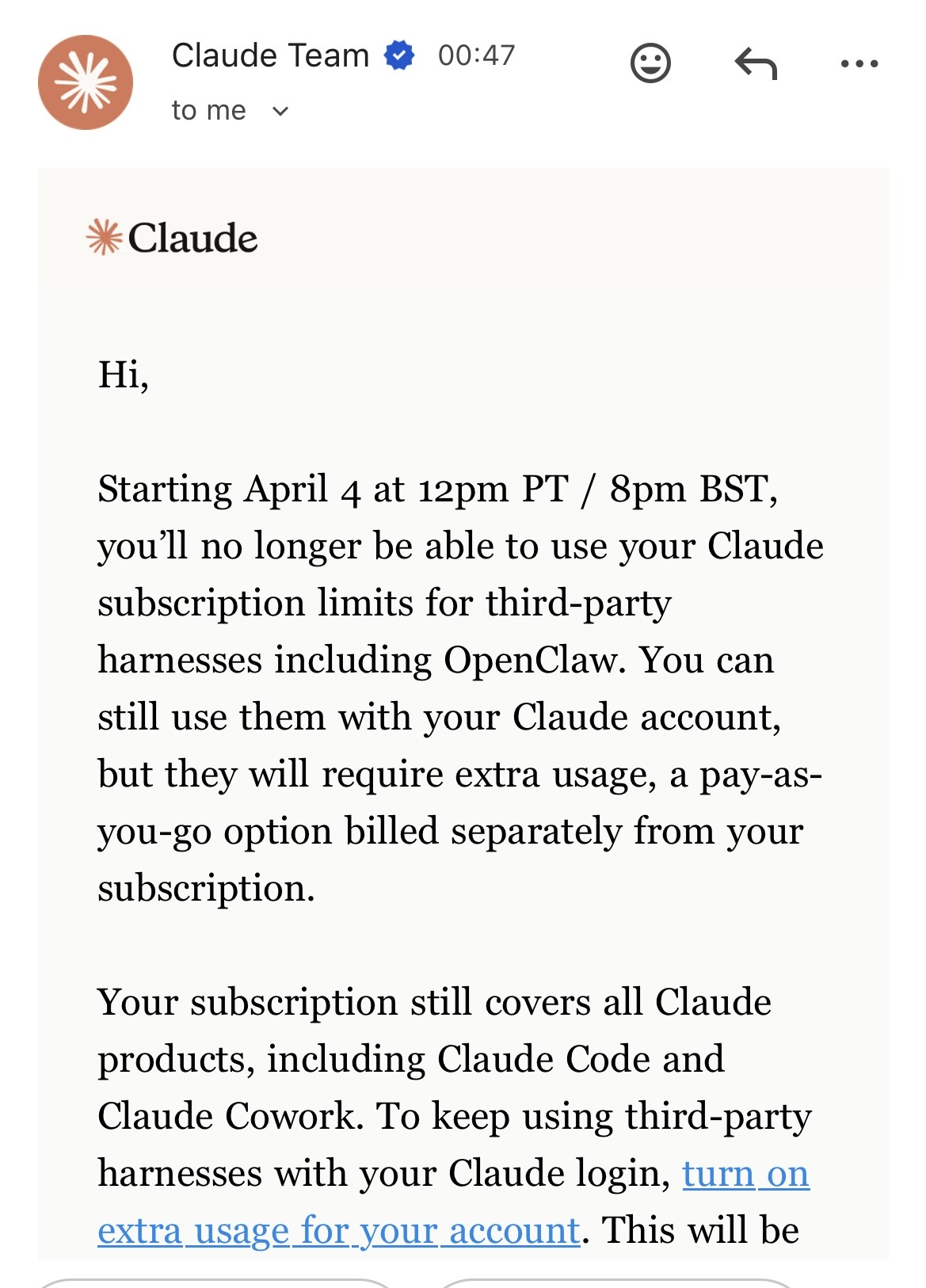
Think about what this means. A user paying $20 or $200/month for Claude Pro could previously use that subscription to power their OpenClaw agent. Now? Per-token API rates. For any meaningful agentic workload, that’s orders of magnitude more than the subscription.
Anthropic’s own email states that the subscription “still covers all Claude products, including Claude Code and Claude Cowork.” So Anthropic’s own agentic tools get the subscription benefit, but the open-source ecosystem that drives adoption and innovation does not.
This is a walled garden strategy. Anthropic is saying: you can use agents, but only our agents. If you want to use the open ecosystem (OpenClaw, custom harnesses, third-party tools), you pay full price.
For the agentic era to succeed, frontier models need to be accessible. Not just to enterprises with API budgets, but to individual developers, students, researchers, and small teams who are building the future of autonomous computing. Locking them out of affordable access is a step backwards.
Open Models and Local Hardware: The Real Future of Agents
But there’s another path. And it doesn’t depend on any provider’s goodwill.
Open Models: The Exit Strategy
Open models running on local hardware are the answer to the affordability crisis. And they’re getting good enough, fast enough, that the cloud providers should be nervous.
Two model families are leading this in 2026.
NVIDIA Nemotron is built specifically for agentic AI. The Nemotron 3 family comes in three sizes: Nano, Super (120B parameters), and Ultra. The trick with Nano is its MoE design: 30B total parameters, but only 3B fire per inference. That means you get the intelligence of a much larger model with the compute cost of a small one. Context window up to 1 million tokens. Deploy it with Ollama, llama.cpp, or vLLM on any NVIDIA GPU. When NVIDIA, the company building the infrastructure for the entire AI industry, is pouring resources into open models, you know where the market is going.
Google Gemma 4, released just days ago by DeepMind, is the other one to watch. It ships in four sizes, from a 2B edge model to a 31B dense model that currently ranks #3 in the world on Arena AI’s text leaderboard. The 26B MoE variant uses only 4B active parameters, same trick as Nemotron. All models process video and images natively, support function calling, structured JSON output, and context windows up to 256K tokens. The 31B model runs on a single RTX 3090. I’ve tested Gemma for agent workloads that need to process images, documents, and text together. It works. Not as sharp as Claude Opus for complex reasoning, but for 80% of what an agent does daily? More than enough. And it’s Apache 2.0 licensed.
Both are completely free to download, run, and modify. No API keys. No billing surprises.
Your AI, Your Hardware
If I were building a local agent setup today, I’d start with a used NVIDIA RTX 3090 (24GB VRAM, $650-$750). That single card runs most 7B to 70B parameter models at usable speeds. On a budget? An RTX 3060 12GB (~$190 used) gets you in the door for around $500 total system cost.
The key metric is VRAM. Agents eat more memory than simple chat because they maintain persistent context windows and run multi-step tool-calling loops. Plan for 24GB minimum if you’re serious about it.
The math kills the cloud argument. $1,000-$1,500 upfront, then zero ongoing costs. That’s one to three months of API fees. After that, you’re running agents for free. Forever. And no provider can pull the rug out from under you on a Friday afternoon.
I run my agents on a Raspberry Pi 5 today. After Anthropic’s move, I’m accelerating the migration to more powerful local hardware. Lesson learned: own your infrastructure.
The Hybrid Play
In practice, the smartest approach is a hybrid architecture. Run local open models for routine agent tasks: email triage, code generation, scanning, monitoring. Reserve API calls to frontier models for the tasks that actually need frontier intelligence: complex multi-step reasoning, nuanced security analysis, architectural decisions.
OpenClaw already supports this. Configure Ollama for standard work, Claude or GPT-4.1 as fallback for heavy reasoning. The community is building better routing tools every week.
The message to AI providers: if you price out the ecosystem, the ecosystem moves on. The gap between open and proprietary models is closing faster than your pricing committees think.
What Should Happen Instead
Companies: Do More With More
Follow Jensen Huang’s advice. When AI gives you more capability, use it to do more, not to fire people. Give every employee an AI agent. Let them become superhumans. The company that turns 100 employees into 100 superhumans will outperform the company that fires 80 and keeps 20 managing bots.
Your employees have context. They understand your customers, your products, your market. An AI agent doesn’t have that. It has pattern matching and token prediction. Combine the human context with the AI capability, and you get something neither can achieve alone.
AI Providers: Make Agents Affordable
Create agent-specific pricing tiers. Not enterprise contracts with six-figure minimums. Not per-token billing that punishes autonomous workloads. Real, affordable plans that let individual developers and small teams run agents without going bankrupt.
Agent subscription tiers at $50 to $100/month for reasonable agentic usage. Open-source ecosystem discounts for verified agent platforms. Graduated pricing with free initial tokens. Or the simplest fix: just let subscription users run third-party agents.
The providers who figure this out will capture the agentic market. The ones building walled gardens will lose to open alternatives. And those alternatives get better every month.
Everyone: Invest in Open Models and Local Infrastructure
Stop waiting for cloud providers to lower prices. Buy a GPU. Set up Ollama. Download Nemotron or Gemma. Run your agents locally.
$1,500 upfront. Zero per month. No one changes the rules on you. That’s sovereignty over your AI infrastructure, and in 2026 the hardware is there to make it real.
The Bottom Line
AI is the most powerful amplifier of human capability ever created. Every person with an AI agent becomes more productive, more creative, more capable. That’s not a threat. That’s the opportunity.
But we need three things to happen.
Companies need to choose empowerment over elimination. Layoffs driven by AI are a failure of imagination, not a triumph of technology. Multiply your people. Don’t replace them.
AI providers need to make agents affordable. An agentic era that only enterprises can access is not a revolution. It’s a consolidation of power. The developers, freelancers, and small teams who drive real innovation need access at prices they can sustain.
And the community needs to keep investing in open models and local infrastructure. Nemotron, Gemma, affordable GPUs, self-hosted agents. That’s the path to an agentic future no corporation can gatekeep.
Anthropic just locked subscriptions out of third-party agents. That’s a mistake. The open-source community will route around it, and the market will eventually punish walled gardens that hold back adoption.
AI should make superhumans. Not unemployed.
- X (Twitter): @SimonRoses
Further Reading:
- Professional Vibe Coding vs. Vibe Coding
- My Experience Using OpenClaw: A Security Professional’s Journey
- The Shadow Twin Threats: When AI and Vibe Coding Go Rogue
- JustPaid Replaces Developers with OpenClaw Agents (Futurism)
- NVIDIA Nemotron: Open Models for Agentic AI
- Google Gemma 4: Byte for Byte, the Most Capable Open Models
- AI Homelab: Hardware to Software Considerations
- r/homelab: AI Homelab Build Discussion
- Veracode: 2025 GenAI Code Security Report